Video Series
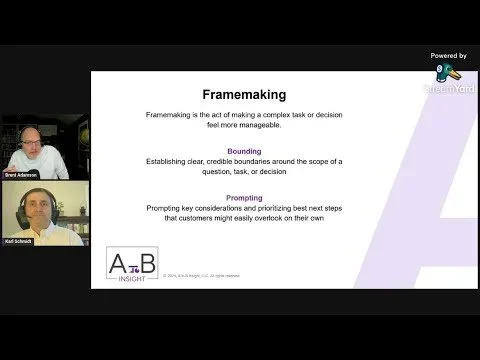
Framemaking Foundational
-
![]()
Customer Self Confidence
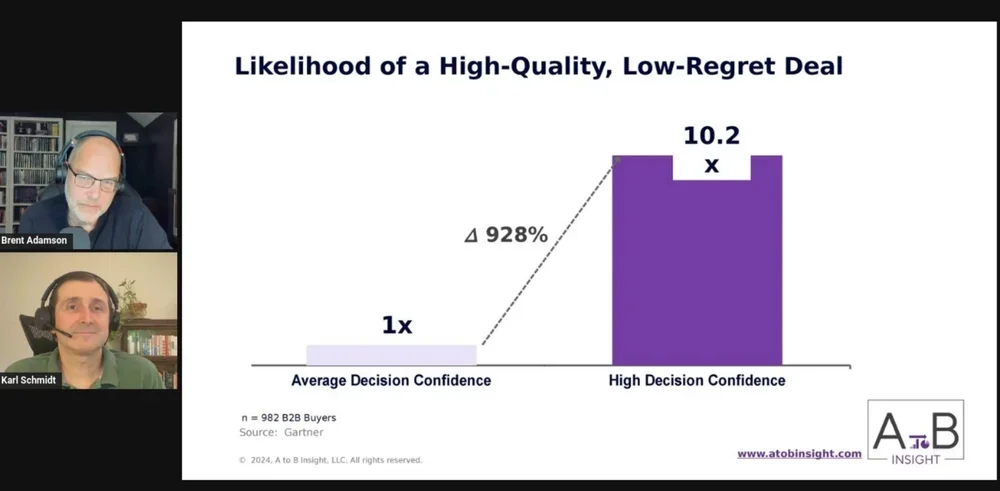
Watch as we reveal that the single most important factor driving a high-quality, low-regret purchase—increasing its likelihood by nearly Episode 1, "Customer Self-Confidence," reveals that the single most important factor driving a high-quality, low-regret purchase—increasing its likelihood by nearly 980% (a 10x increase)—is the customer's self-confidence in their decision-making process, rather than their confidence in the supplier
-
![]()
The One Question
This week, we’re diving into the heart of The Framemaking Sale. Every supplier wants growth—more deals, deeper loyalty, stronger relationships. But research shows it all comes down to one thing: customer Decision Confidence. Not confidence in you—in themselves. Framemaking is about helping customers feel more certain in the decisions they make. That’s the real driver of growth.
-
![]()
The Tara Story
A top sales leader's initial reaction, "I don't want anyone else to read this book!" quickly turned into praise for "The Framemaking Sale," which offers B2B sellers a practical, step-by-step strategy to stand out against competitors and technology like AI.
-
![]()
Your True Value as a Seller
Despite the common belief that demonstrating your expertise builds customer trust and speeds up sales, this video reveals the counterintuitive idea that focusing on your own experience can actually undermine your goals, suggesting that building the customer's self-confidence through "access" is the true, shorter path to driving bigger, better sales.
-
![]()
The One Thing Bigger Than AI
The Framemaking Sale focuses on the human element in B2B sales, arguing that in an AI-driven world where buyers prefer self-service, the key to success is becoming the indispensable seller customers actually want to engage with, using well-designed human interaction to foster confidence and drive growth.
-
![]()
Framemaker vs. Framemaking
The difference between "er" and "ing" makes all the difference in the world when you're trying to motivate others and inspire real, material change. It's the difference between identity and behavior. And that difference can mean everything when it comes to real results.
-
![]()
Customer Agency
“Agency:” a term few if any typically associate with B2B sales and marketing. Even more precisely, "customer agency." Does it sound a bit wonky? Probably. Is it also critically important for maximizing the likelihood of a high-quality, low-regret deal? Undoubtedly, yes.
-
![]()
Organize Customers' Thinking
The Smartness Arms Race is on! We're all saying really smart things, so "being smart" is just as commoditized as our solutions themselves. And worse still, our customers are really overwhelmed and confused by all this information. How do we stand out now?
-
![Episode 9]()
The Capital Review Board
The Framemaking Sale is full of stories. Each bearing a familiar feel and a powerful lesson. One of our favorites is the "capital review board story." In it, we find the core of Framemaking: How do we help customers feel more confident in themselves and their ability to make large, complex decisions on behalf of their company?
-
![Episode 10]()
Seller Relevance
What if your sellers' biggest challenge today isn't their skill, but their relevance? Skills matter, but only in the service of relevance first. Let's make sure we're building the seller skills that ensure your sellers are actually relevant in the eyes of your customer.
-
![Episode 11]()
A Framemaking Ontology
You could've knocked me over with a feather when someone told me that the heart and soul of The Framemaking Sale isn't methodological, but ontological. Wait, what? But you know what? He was absolutely right. Here's why.
-
![Episode 12]()
The Real Value of Deep Experience
The thing I find most humbling about running Framemaking workshops is repeatedly learning that there's so much more to understand about the very concept you're teaching--the thing you're purporting to understand sufficiently well to qualify for teaching it in the first place. Here’s an example.
-
![Episode 13]()
What Are You Seeing out There?
Sometimes, a simple observation perfectly captures a broader point like Framemaking. Case in point: A recent conversation Karl and I had with a global head of sales. By sharing a simple observation about her "top-to-top" customer interactions, she captured the heart and soul of Framemaking in a neatly compact way . Here's how.
-
![Episode 14]()
The Other Side of Discovery
How do we engage customers in a way purposefully designed to positively impact their self-perception, and not just their supplier-perception? Ultimately, it's that kind of capacity that we hope customers can discover in us. So what would that kind of discovery conversation have to look like?
-
![Episode 15]()
Ghosting
What do you do when a customer simply stops engaging? We have a natural tendency to blame ourselves when this happens. But what if some customers, at least, are ghosting for a completely different reason altogether? Here’s a totally different way of thinking of ghosting altogether.
-
![Episode 16]()
Discovery through Framing
What if we were to provide value, before seeking to extract value in a discovery conversation? What would that sound like? In Framemaking, the "Phrase that Frames" provides a powerful, practical tool to make that happen. Here's how.
-
![Episode 17]()
Why Framemaking Matters
If we're gonna do hard things, it really helps to understand why we're doing them. After all, even the simplest tasks require a constant calculus of "Is it worth it?" That's the power of Framemaking. No matter who you are, how you're wired, or where you seek motivation, Framemaking offers a potentially powerful return.
-
![Episode 18]()
The Annabel Story
Today's commercial reality means every ~2 years or so there's some new customer stakeholder at the table who wasn't there before, leaving buyers struggling to navigate their own internal decision complexity. The upshot for sellers? Most will see struggle. The best will see opportunity. Here’s how, in a real-world story.
-
![Episode 19]()
Your Biggest Overlooked Competitor
Your single biggest competitor today is likely something most sellers are completely overlooking. And weirdly, it has little to nothing to do with you at all. It's your customers’ memory. What does that even mean and what do we do about it? Here's a thought.
-
![Episode 20]()
Handling Customer Objections
Some customer concerns center on specific supplier capabilities. Others are completely supplier agnostic. Addressing the latter with a response designed for the former not only leaves customers’ concerns unaddressed, but far worse does actual damage. Here’s how and what to do about it.
-
![Episode 21]()
Curiosity: The Sales Superpower
The simple exhortation “be curious” has always rung a little hollow. Not because it’s incorrect, but because it feels incomplete, at least in terms of practical execution. Here’s a practical way to turn curiosity from helpful skill to selling superpower.
-
![Episode 22]()
Save for Later
Imagine a group of 5-10 people trying to understand a complex solution on behalf of their company. The risk that at least one of them—if not several—wind up in infinite learning loops isn’t just high, it’s almost a certainty. Framemaking provides a means to help humans navigate the minefield of today’s complex decisions.
-
![Episode 23]()
Words Matter
In the world of Framemaking, a whole new world of words opens up to sellers that's been there all along. It's the world of human connection. And most of us are walking right past it. Here's how we get after it with Framing.
-
![Episode 24]()
Mutual Plan & Sequence of Events
If there's one thing today’s B2B buyers need more than ever, it's a roadmap. Guidance. Help. And this is where the Mutual Plan (or a "sequence of events") in the hands of a Framemaking Seller becomes a completley different kind of tool for selling more by selling different. Here's how.
-
![Episode 25]()
Aligning Stakeholders
If we can get customers to see our value, they'll buy. Especially if we "multithread" across all relevant stakeholders. Yet, more often than logic should allow, customers don't buy. So what happened? Did they not really see our value? Here’s an answer and a way to help.
-
![Episode 26]()
Reducing Outcome Uncertainty
When it comes to value realization, often customers don’t doubt your value, credibility, or your ability to execute. They just believe that "they're different," and as a result, they’ll underperform against expectations. This isn't a problem of supplier confidence but customer self-confidence.
-
![Episode 27]()
Customer Agency
Customer agency. It's kind of a wonky term. And certainly one we don't often use when exploring B2B sales excellence. But it turns out, it's absolutely crtical for B2B sales success. Here's why. And more importantly, what to do about it.
-
![Episode 28]()
Become Your Customer's Decision Coach
Ideas like the "Phrase that Frames," building "customers' self-confidence," and "running right at" customer buying obstacles in a "supplier-agnostic" manner all matter for Framemaking. But the idea that captures it all in a neat, memorable package becoming your cusotmer's "Decision Coach."




Framemaking: The Big Picture
-
![]()
The Critical Role of Customer Confidence
We’re deep into Chapters 5 and 7, wrestling with words and titles that just won’t sit still. Writing a book is a journey through the human side of selling, buying, and connection. Follow along as we share what we’ve learned—and what our book is definitely not called. 😄
-
![]()
The History of B2B Sales in 1 Slide
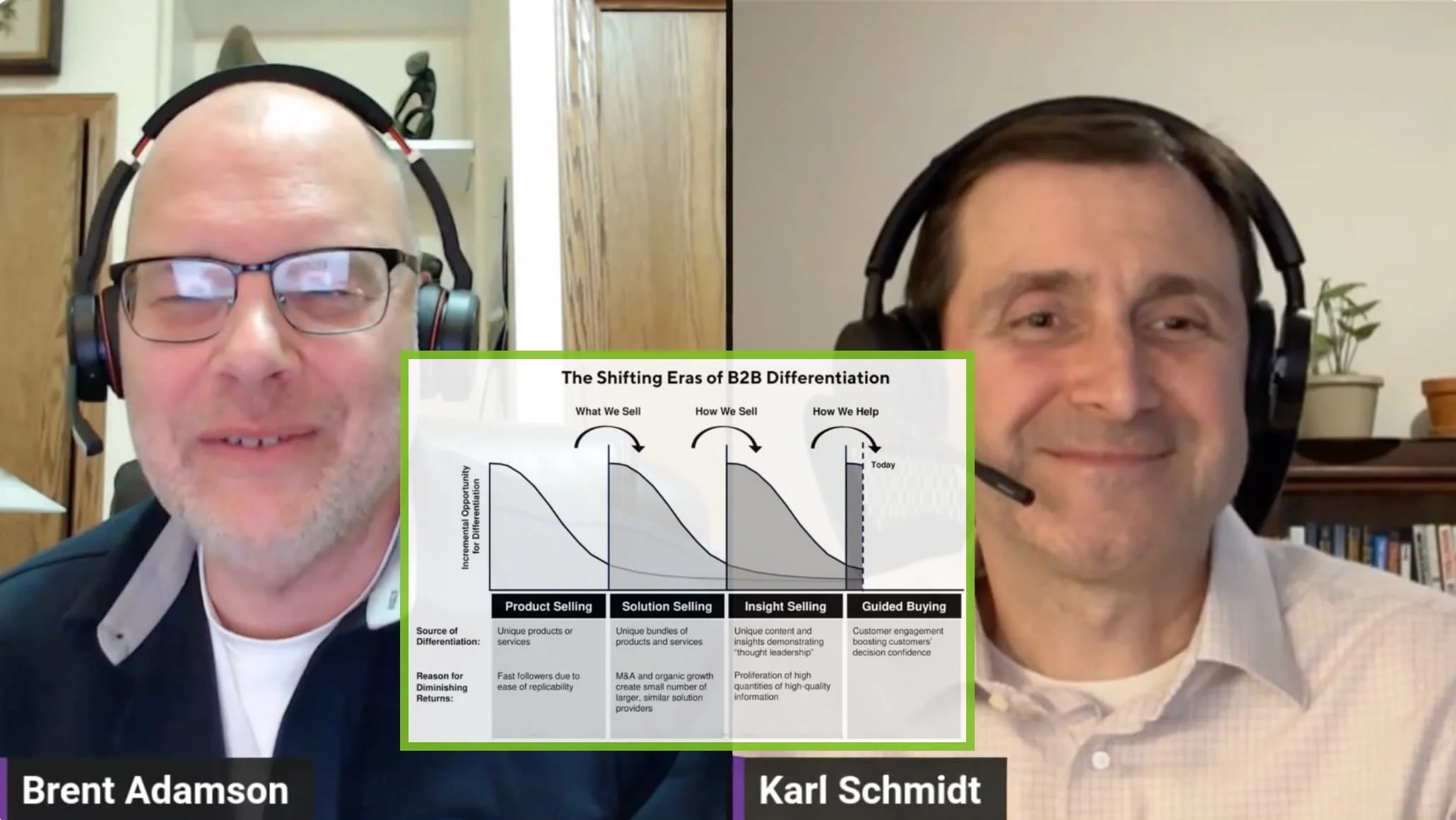
A short lesson on the history of B2B sales across the last ~30 years, and why it all feels so broken. And, what to do about it.
-
![]()
What the Heck is "Framemaking?
What is Framemaking—and how does it help us sell more? It’s a fresh approach to selling for today’s buyers, built on a new mindset that changes every conversation. Early adopters are already seeing powerful results. This isn’t The Challenger Sale 2.0—it’s something entirely new. Don’t wait 15 years. Let’s roll.
-
![]()
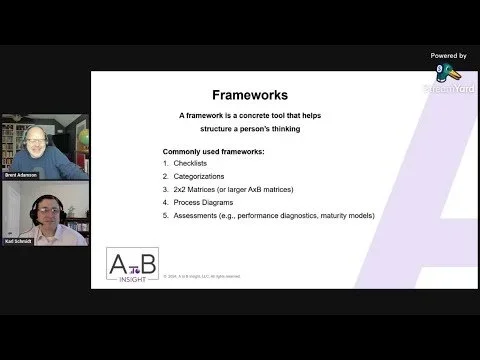
Is It Framing or Frameworks?
Karl Schmidt and I are back with our latest Framemaking Sale conversation.
This week: framing vs. frameworks—and why they matter.
Frameworks help customers organize their thinking, see more clearly, and make bigger, better decisions.
Long used in teaching and consulting, they may just be sales’ next big unlock.
-
![]()
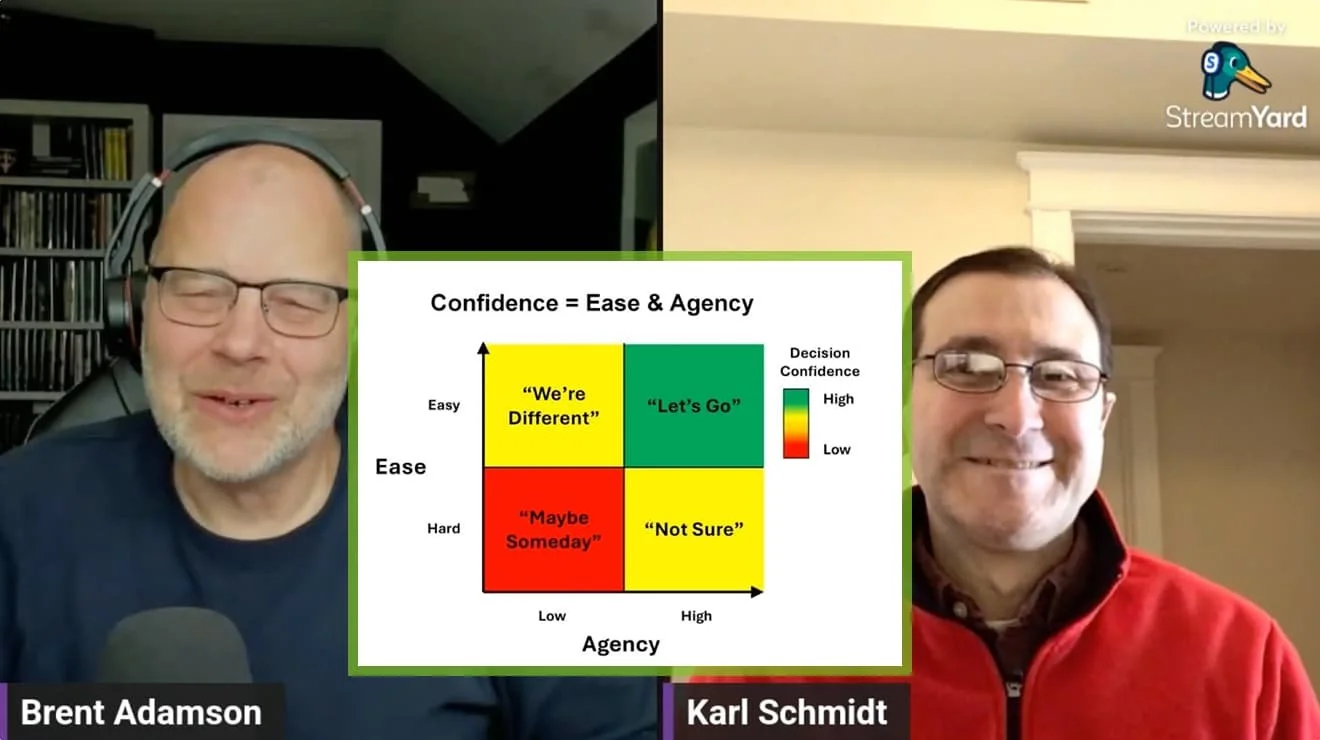
The Secret Sauce of Ease and Agency
Brent and Karl talk about how much of what is called "customer centricity" is actually "customer coercion"—a supplier-centric effort to control customers' perceptions—and introduce the concept of fostering customer agency and self-confidence as the true driver of high-quality deals.
-
![]()
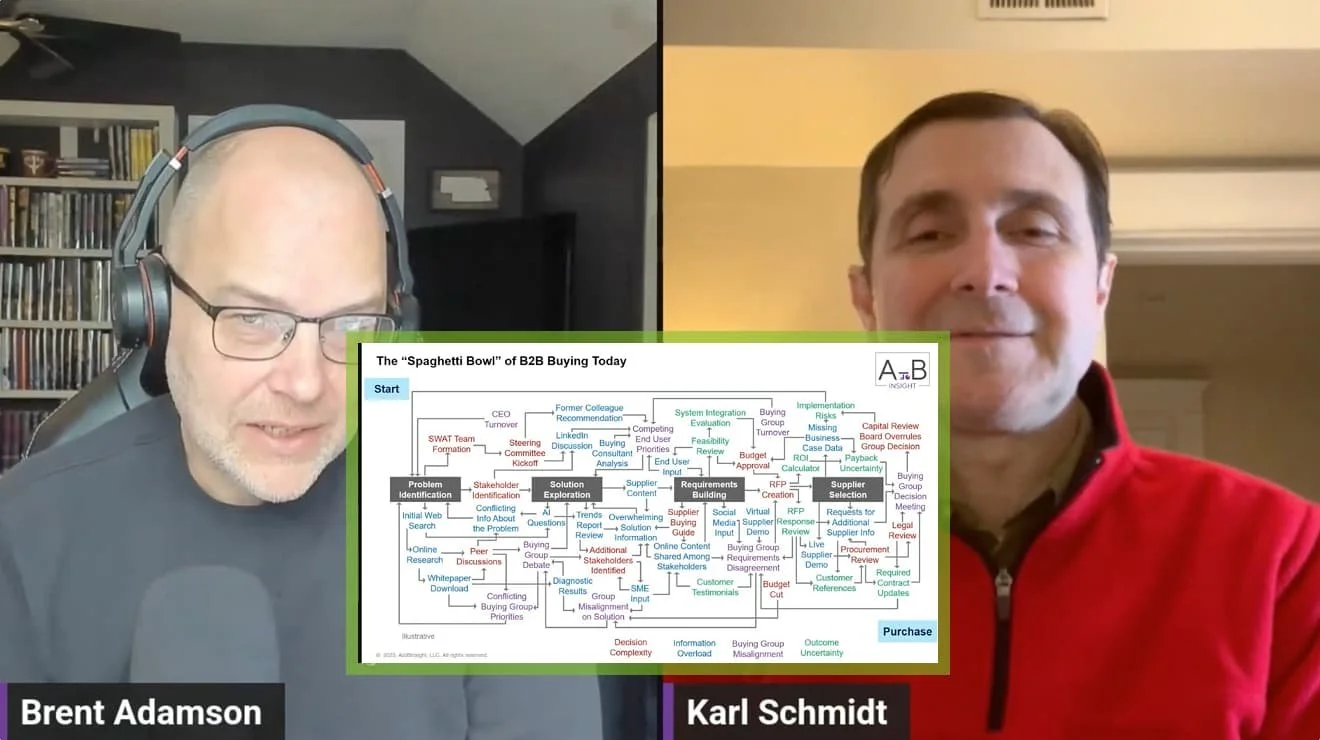
B2B Buying is a Mess!
Brent and Karl talk about the difficulty of mapping the customer's buying journey when customers view it as long and difficult, suggesting that sellers have an opportunity to be a valuable "guide, or coach"—not just a solution—by using their "Framemaking" approach to help customers feel more confident navigating complex B2B purchases.
-
![]()
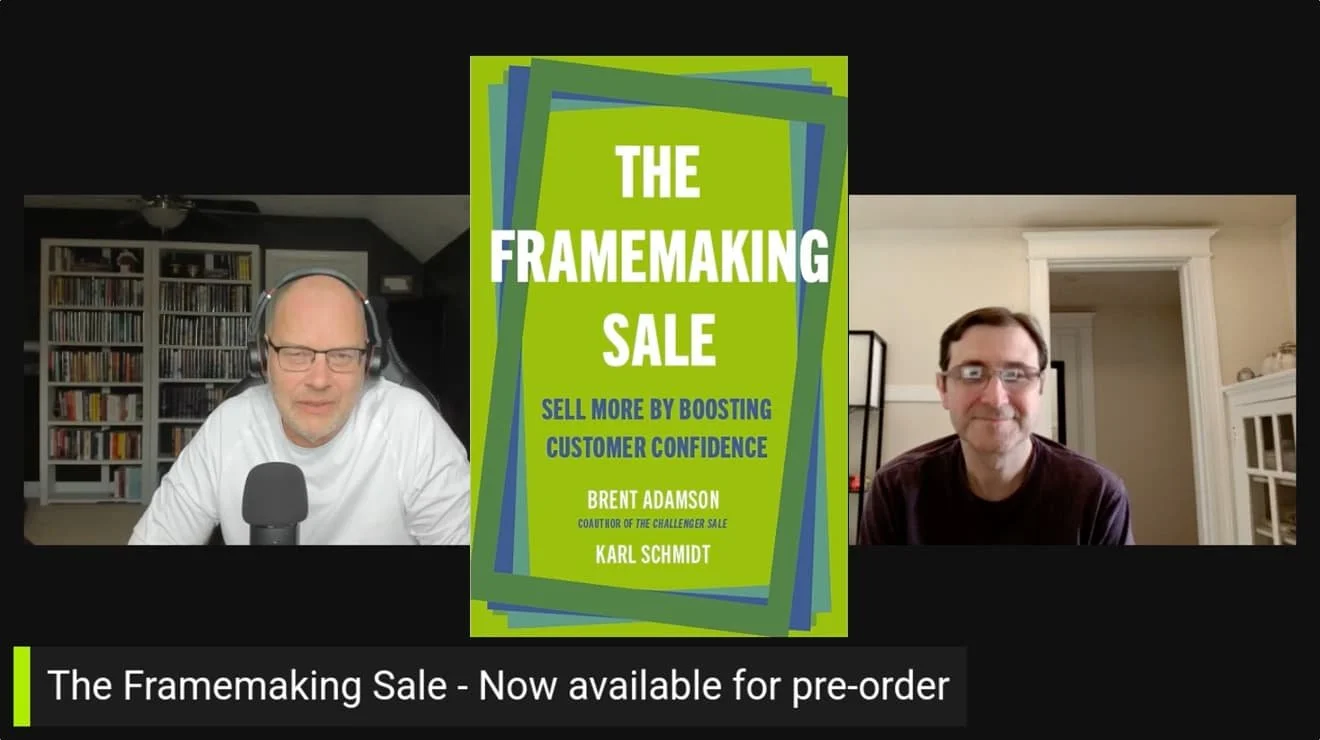
The Big Book Cover Reveal!
Wait... you chose LIME GREEN?!?!
-
![]()
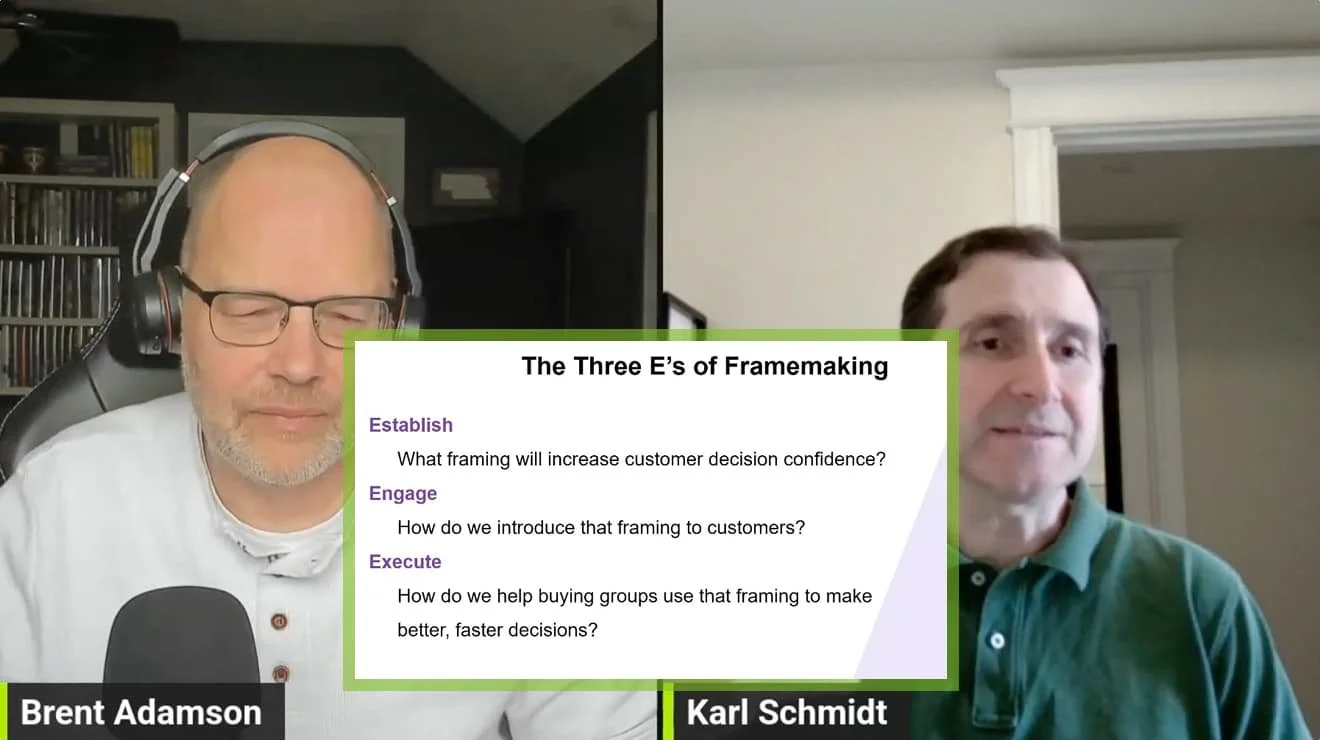
The 3 E's of Ease
Brent and Karl explore the "3 E's" of Framemaking—Establish, Engage, and Execute—a practical framework designed to help sellers frame customer buying decisions in a way that boosts their decision confidence, starting with the first step of Establishing what is undermining that confidence.
-
![]()
Mindset, not Methodology
Brent and Karl talk about introducing a new "Framemaking" mindset to B2B sales and marketing, which they argue is needed more than another sales methodology because it helps sellers rethink their core purpose and adapt their existing playbooks to today's buying environment where customers struggle to buy.
-
![]()
Ghosting
Brent and Karl talk about the frustration of customer ghosting and how they view it not just as a sales challenge, but as a powerful opportunity to stand out and sell more by focusing on the human connection—which they argue is the true higher value activity in B2B sales that AI is supposed to free up time for.
-
![]()
The Four Worst Words
Brent and Karl talk about the traditional assumption that customers know more about their own buying journey than sellers, but argue that sellers often have greater insight into how to navigate internal decision complexity—especially when customers face unforeseen obstacles—creating an opportunity for sellers to provide coaching and guidance through Framemaking.
-
![]()
Your Role as a Connector
Brent and Karl talk about the September 9, 2025 release of The Framemaking Sale and introduce the "Connector" seller role, arguing that a seller's true value comes from providing customers with access to lessons learned from other similar customers, thereby increasing decision ease and self-confidence through the "Phrase that Frames."
-
![]()
Customer Centric vs. Supplier Agnostic
Brent and Karl talk about the common confusion between "customer centricity" and "supplier centricity," exploring what true customer centricity would look like if it were supplier agnostic and addressing the crucial question of how a business practicing this approach would get paid.